Change and Change Management & Transformation Consultancy
Most change programmes are not lost at the design stage. They are lost in the six months afterwards, when the new structure is live, the town hall is over, and people quietly go back to the way they worked before.
The shift is simple to say and hard to do. Stop treating change as a project to be announced, and start treating it as something people have to live with. That means designing the structure, culture, and communication together, not in sequence. It also means asking people to keep delivering today while becoming capable of what the new model needs, and planning for both, because treating those as competing demands is how transformations quietly stall.
Let’s Talk Talent is a people-first HR and organisational consultancy with around 30 years of global expertise, named HR Consultancy of the Year at the Personnel Today Awards. We help you restructure, merge, redesign, scale or shift culture in a way that holds once the consultants have gone.
How Let’s Talk Talent Can Help Your Team

Change Management & Transformation Consultancy
They are lost in the six months afterwards, when the new structure is live, the town hall is over, and people quietly go back to the way they worked before.
The shift is simple to say and hard to do. Stop treating change as a project to be announced, and start treating it as something people have to live with. That means designing the structure, culture, and communication together, not in sequence. It also means asking people to keep delivering today while becoming capable of what the new model needs, and planning for both, because treating those as competing demands is how transformations quietly stall.
Let’s Talk Talent is a people-first HR and organisational consultancy with around 30 years of global expertise, named HR Consultancy of the Year at the Personnel Today Awards. We help you restructure, merge, redesign, scale or shift culture in a way that holds once the consultants have gone.
Change & Transformation Services
Every change and transformation engagement at Let’s Talk Talent starts with business context, not with a framework. We want to know what is actually driving the change, what has already been tried, what your people believe about the last programme, and what has to be true in eighteen months for this one to count as a success. Only then do we scope the work.
The services below are modular. You can commission a standalone culture audit, a full target operating model redesign, or a change management strategy that wraps around a transformation your team is already running. Delivery is blended across diagnostics, facilitated leadership sessions, workshops, sprints, and one-to-one coaching, in person, virtually, or in hybrid formats, across single sites and global operations.

Organisational Design & Target Operating Models
Structure that matches your strategy, not your history.
Most organisation charts are an archaeological record. They show the acquisitions, the reorganisations, and the individual hires of the last decade, layered one on top of the other. The result is duplicated effort, unclear accountability and decisions that take four meetings when they should take one.
Organisational design fixes the underlying logic. We work backwards from your strategy to define the work that needs to happen, the capabilities required to do it, how those capabilities should be grouped, and where decision rights sit. Then we design the target operating model that delivers it, balancing efficiency, agility and employee experience rather than optimising for one at the cost of the others.
We also design the transition. A target operating model that cannot be reached from where you are today is a diagram, not a plan.

We map the moves, sequence them, identify the roles most at risk of overload, and build the consultation and communication approach alongside our colleagues in HR and legal.
- Target operating model design and role architecture
- Spans of control, layers and decision rights mapping
- Accountability and RACI clarification across functions
- Capability and skills gap analysis, plus workforce planning for the future shape
- Transition roadmaps, consultation support and post-restructure embedding
Best for: post-acquisition integration, scaling businesses outgrowing their structure, and cost reduction programmes that need to protect capability.
Culture Audits & Culture Change
Find out what your culture actually is before you try to change it.
Culture is not the values on the wall. It is what gets rewarded, what gets tolerated, and what people believe will happen if they speak up. A culture audit gives you that picture, backed by evidence, so culture change stops being a matter of opinion.
Let’s Talk Talent runs culture audits using a blend of quantitative and qualitative methods: employee surveys, focus groups, one-to-one interviews, leadership behaviour observation, and tools such as the Emotional Culture Deck to surface how people actually feel about working with you. We look at belonging, values alignment, psychological safety and the adaptive behaviours that determine whether your organisation can absorb change at all.
Then we help you act on it. That means defining the small number of behaviours that genuinely matter, building them into how you recruit, manage, promote and reward, and equipping managers to model them. Culture change fails when it stays a communications exercise. It works when it is built into the organisation’s everyday machinery.
- Culture diagnostics: surveys, focus groups, interviews and listening sessions
- Values and behaviours definition, refresh and articulation
- Psychological safety, inclusion and belonging assessment
- Leadership behaviour alignment and role-modelling support
- Embedding culture into performance, reward and management practice
Best for: organisations after a merger with two cultures to reconcile, businesses shifting to hybrid working, and leadership teams who suspect engagement scores are not telling the whole story.

What is Change Management?
Change management is the structured practice of preparing, supporting and equipping people to adopt a new way of working, so that a business change delivers the results it was designed to deliver. It sits alongside the technical or structural work rather than replacing it. The system goes live either way; change management determines whether anyone uses it properly.
Here is the distinction that matters. Change management is about helping people adopt a change. Transformation is about changing what the organisation fundamentally is. One is a discipline applied to a defined shift, such as a new operating model or a merger. The other is a multi-year rewiring of strategy, structure, culture, and capability simultaneously. Most organisations need both, and most confuse them, which is why so many transformation programmes are resourced as if they were projects.
In practice, change management covers stakeholder analysis, impact assessment, the change narrative, communication planning, manager enablement, training and capability building, resistance management and adoption measurement. It is not internal communications, and it is not a training course bolted on at the end. It is a discipline that starts at the point the decision is taken and continues well past go-live.
What is a culture audit?
A culture audit is a structured diagnostic that measures an organisation’s actual culture, using employee surveys, focus groups, interviews and behavioural analysis, to reveal the gap between stated values and lived experience. Let’s Talk Talent typically completes one in four to eight weeks, and the output is a clear, evidenced picture of what is working, what is quietly blocking progress, and which behaviours to change first.
Change Management vs Transformation: A Direct Comparison
People use the two terms interchangeably, and it costs them. Resourcing a transformation as if it were a change programme is one of the most common reasons transformations stall. Here is the difference, side by side.
| Change Management | Transformation | |
| What it is | A discipline applied to a defined shift, to help people adopt a new way of working | A fundamental change to what the organisation is: its strategy, structure, culture and capability at once |
| The core question | Will people actually adopt this change? | Should the organisation become something different? |
| Scope | A specific, bounded change, such as a new operating model, system or merger | Multiple bounded changes rewired together over a sustained period |
| Time horizon | Weeks to months, running from the decision through to well past go-live | Typically 12 to 24 months, phased to deliver early wins |
| Governance | Programme or workstream governance sitting alongside the technical delivery | Board-level ownership, its own operating rhythm and a longer investment horizon |
| What “done” looks like | The change is adopted and delivering the benefits case it was designed for | The organisation is operating in a genuinely new way, and it holds |
| Biggest risk | An announcement and a hope: the system goes live, but people revert | Running a multi-year rewiring on project timelines and project governance |
| When you need it | A restructure, a new system, a redundancy programme, a leadership transition | A shift in business model, culture, structure and capability happening together |
Most organisations need both, and most confuse them. A restructure or a new system needs change management. A simultaneous shift in business model, culture, structure, and capability is a transformation, and it requires a longer horizon and different governance. Let’s Talk Talent scopes both, and will tell you honestly which one you are actually undertaking.
Why Change & Transformation Matters to Your Business

Structure that supports the strategy
Clear accountability and sensible spans of control remove the duplication and delay that quietly drain productivity.

Change that survives contact with reality
Programmes designed with adoption in mind deliver the benefits case rather than a revised benefits case.

Capability for the shape you are becoming
Skills gap analysis and workforce planning mean you build or buy the right capability before you need it, not after.

Certainty where certainty is possible
Honest, well-sequenced communication reduces the rumour cycle that does most of the damage during uncertainty.

Managers who can hold the conversation
Equipped line managers turn the most anxious moments of a change into trust rather than attrition.

A culture people recognise afterwards
Evolving culture deliberately means you strengthen identity through change instead of losing it.
How Let’s Talk Talent Approaches Change & Transformation
Change buyers are right to be sceptical, so here is the method in full. Every engagement runs through four stages, and we agree the success measures at the start, not at the review.
1. Discover We get to the real driver of the change by interviewing leaders, reviewing existing data and mapping who is affected and how, before anything is designed. Typical timescale: 1 to 3 weeks.
2. Diagnose We run the evidence-gathering: culture audits, talent reviews, skills gap analysis, structural analysis, engagement data and 360-degree feedback where leadership behaviour is part of the problem. Typical timescale: culture audits take 4 to 8 weeks end to end.
3. Design We design the target operating model, the values and behaviours, the change narrative and the communication and capability plan together, testing each with the people who will live with it. Typical timescale: organisational design engagements run 3 to 6 months.
4. Deliver & Embed We support delivery through facilitation, manager enablement, coaching and change champion networks, then measure adoption with pulse surveys and pre- and post-diagnostics so the change holds. Typical timescale: full organisational transformations run 12 to 24 months, phased to deliver early wins.
We phase deliberately. A transformation with no visible progress in the first quarter loses the organisation’s confidence, and confidence is the thing you cannot buy back. You can read more about how we work with client teams, including how we augment internal change functions rather than displace them.
Our Clients
Let’s Talk Talent has supported change and transformation for organisations including Hearst, Warner Bros., King’s Fund, Vodafone, Nokia, ForGood Tech, Lifearc and King’s College London, across restructures, operating model redesigns, culture programmes and post-acquisition integration.


Change & Transformation FAQs
What is a change management consultancy?
A change management consultancy helps organisations plan, deliver and embed change so that people adopt new structures, systems and ways of working. Let’s Talk Talent works across the full range: diagnostics, organisational design, culture change, communication strategy and manager enablement. We are a people-first consultancy rather than a process house, so our work sits close to your HR and people strategy and always starts with the business context driving the change.
How do we keep people performing while they build the capability the new model needs?
By planning for both from the outset instead of hoping one survives the other. Let’s Talk Talent uses talent audits and skills gap analysis to establish what the new shape actually requires and who already has it or could build it quickly, then phases development so people learn inside the work rather than away from it. We are equally honest about capacity: naming what stops, preparing managers for the workload conversations, and bringing independent diagnostics and facilitation so your internal team is not carrying the change alongside the day job unsupported. What people deliver during a transformation is usually the clearest evidence you will get of what they could take on next.
What types of change and transformation do you support?
Let’s Talk Talent supports restructures, mergers and acquisitions, operating model redesign, post-acquisition integration, scaling, cost reduction, hybrid working shifts, leadership transitions, culture change, and digital and AI-driven change. We also support the people-side work that follows: talent strategy refresh, workforce planning and succession, and employee experience redesign. If the change alters how people work, who they report to, or what is expected of them, it is in scope.
What is the difference between change management and transformation?
Change management is about helping people adopt a specific change. Transformation is about changing what the organisation fundamentally is. A restructure or a new system needs change management. A shift in business model, culture, structure and capability at the same time is a transformation, and it needs a longer horizon and different governance. Let’s Talk Talent scopes both, and will tell you honestly which one you are actually undertaking.
How do you make sure change is people-first, not just structural?
Every Let’s Talk Talent engagement begins with employee listening and an impact assessment, so we know what the change means for real roles before anything is designed. We involve the people affected in shaping the new ways of working, sequence communication so difficult news is delivered properly, and equip managers to hold the conversations. Structure and experience get designed together, which is also how we approach people and team development.
How long do change and transformation projects take?
Culture audits typically take 4 to 8 weeks, organisational design engagements 3 to 6 months, and full transformations 12 to 24 months. Let’s Talk Talent phases every programme so you see meaningful progress in the first quarter rather than waiting for a big reveal. Shorter diagnostic engagements are available if you need an evidenced starting point before committing to a full programme.
Can you work remotely and across international teams?
Yes. Let’s Talk Talent delivers change and transformation work in person, virtually, and in hybrid formats, and has around 30 years of global experience across multi-site and international organisations. Focus groups, leadership sessions and manager enablement all run effectively online, and we design communication cascades that work across time zones and languages. Where in-person presence matters most, usually leadership alignment and consultation, we will say so.
How do you measure the impact of change management?
Let’s Talk Talent agrees measures at the outset and track them throughout: pre- and post-culture diagnostics, engagement pulse surveys, adoption and usage data, talent pipeline strength, retention in affected populations, operational KPIs and leadership capability assessments. We report on leading indicators during delivery, not just lagging ones afterwards, so you can correct course while it still matters. Measurement is built into the plan, never added at the end.
Can you work alongside our internal change team?
Yes, and it is often the best model. Let’s Talk Talent augments internal change and HR teams with specialist diagnostics, facilitation, organisational design expertise and programme support, while deliberately building your team’s capability so the work continues after we step back. We can also support your leaders directly through management and leadership development where the change demands a different kind of leadership.
How can Let’s Talk Talent help with culture change?
Let’s Talk Talent starts with a culture audit to establish what your culture actually is, then helps you define the small set of behaviours that will move the organisation forward. We embed those behaviours into recruitment, management, performance, and reward, and support leaders in modelling them consistently. Where capability is the gap, we design targeted learning and development programmes to build the skills the new culture depends on.
Ready to Make Your Next Change Stick?
Tell us what is changing and what must be true on the other side, and we will honestly tell you what the work involves. Scope and investment are agreed after a discovery conversation, and the first conversation is free.
Case Studies
Designing a future-ready operating model for the UK’s largest health research organisation a target operating model built to match a complex research organisation’s future strategy rather than its historic structure.
Transformative organisational design to enable future growth redesigning structure, roles and accountability so growth was not constrained by the shape of the business.
Revitalising organisational values and behaviours at the UK’s largest library values and behaviours redefined with employees and embedded into everyday management practice.
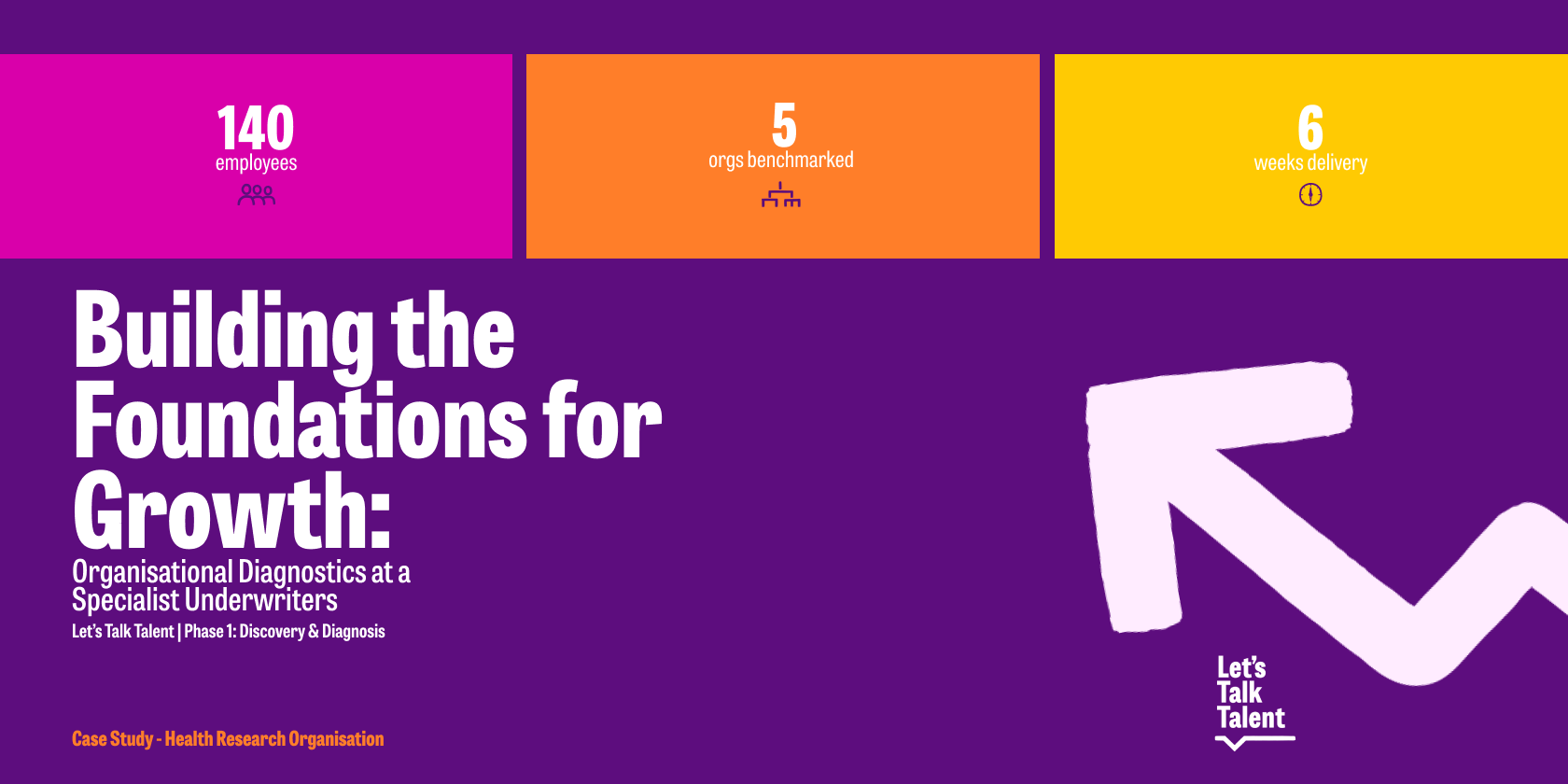
Building the foundations for growth: organizational diagnostics at a specialist underwriter diagnostics that gave a scaling specialist insurer a clear, evidenced starting point for change.
More client work sits in our case study library.
Change & Transformation Resources
We publish practical guidance for HR leaders, transformation directors and executive teams who are in the middle of a change rather than reading about one. Start with these.
Navigating Change: The Strategic Role of HR During Company Transformation where HR adds the most value at each stage of a transformation, and where it typically gets pulled off course.
Download our Six Bright Steps to Leading Change a free, practical framework leaders can use to plan and lead a change programme.
How L&D Can Improve Your Employee Experience how learning and development shapes the experience of change, not just capability.
Reinventing Management & Leadership: Futureproofing for Change what leadership has to look like in organisations that are permanently reshaping.
Everything else lives in our learning and insight hub.